
Changing providers in Australia: rules and costs 2026
10/10/2026October 10, 2026-Nómadas
Australia
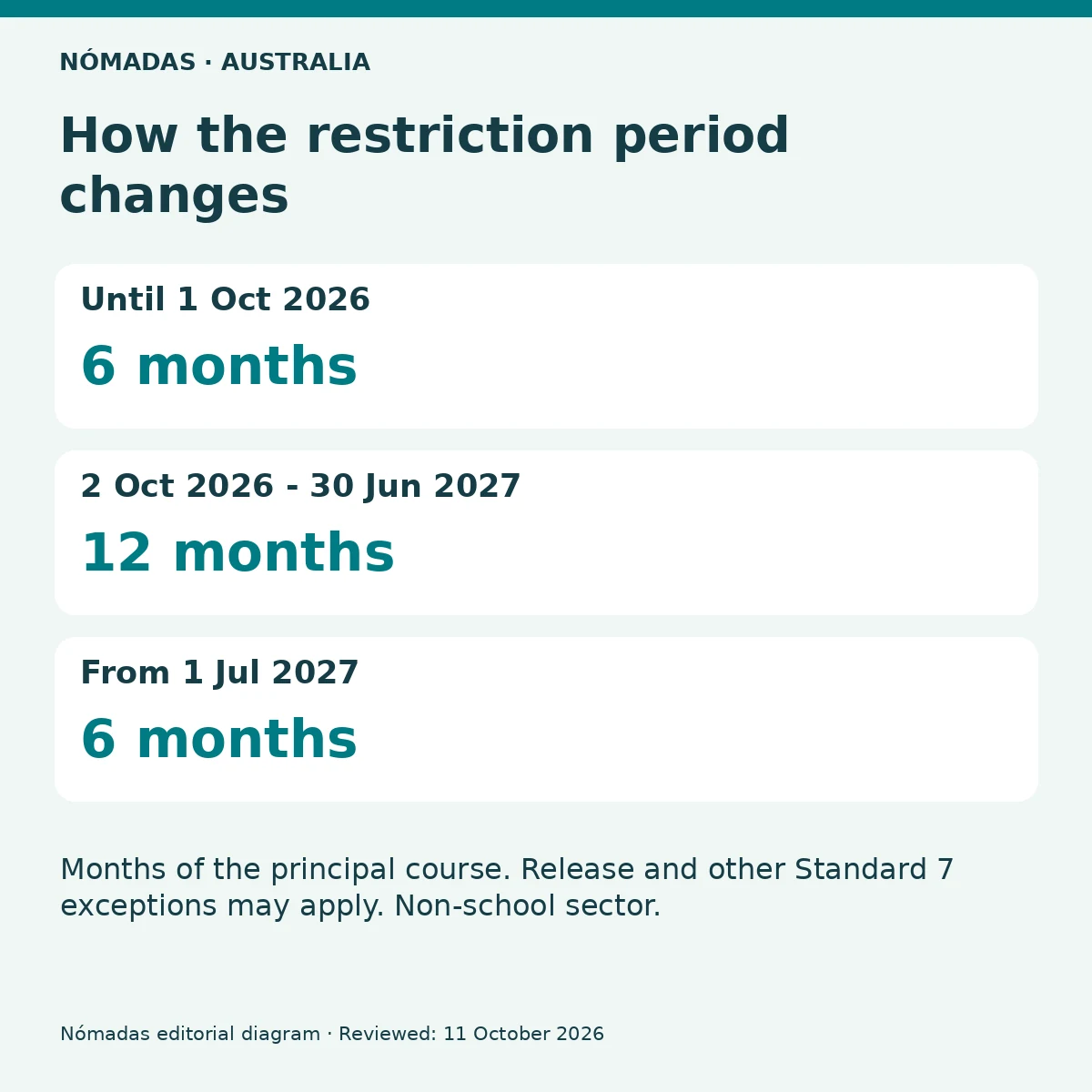
Reviewed 11 October 2026. Australia has temporarily extended the restricted transfer period for overseas students outside the school sector to 12 months of their principal course. The measure applies from 2 October 2026 through 30 June 2027. Transfers are not universally prohibited during that period, but a new provider must respect the applicable release requirements.
Also available: Español · Português (Brasil)
Three checks to organise your plan
- 1
Release
Policy, reasons and supporting evidence
- 2
Agreement
Payments and refund terms
- 3
Visa
Conditions and consequences of a change
A visual summary of changing providers
Visual summary without narration. The full text appears below.
Changing education providers. A visual summary of the Australia guide. Reviewed: 11 October 2026.
A temporary 12-month period. From 2 October 2026 to 30 June 2027, for the non-school sector. It returns to 6 months from July 2027.
Count your principal course. Count from the start of your principal course, not your arrival date or the date the rules changed.
An earlier transfer may be possible. A release or another Standard 7 exception may allow a transfer. The circumstances need assessment and evidence.
Make three separate checks. Release, agreement and visa. Do not pay or cancel solely because you have completed the restriction period.
The Transfer stream is in development. Do not describe it as an available process. Read the full guide and official sources before deciding.
Reviewed: 11 October 2026. ASQA / Study Australia.
When does the 12-month period start?
The reference point is the principal course. It is not necessarily your arrival date or the start of the first component in an English-plus-qualification package. Read ASQA’s student transfer guidance and ask your institution to confirm the principal course and its commencement date in writing.
Keep every Confirmation of Enrolment in your package. Calculating from the wrong course can lead to a mistaken assumption that you are already free to transfer.
Can a student transfer earlier?
A release may be granted under the current provider’s policy and the applicable rules. Other specified circumstances can also permit a transfer, including situations affecting the provider’s ability to continue delivering the course. A new college’s offer alone is not a substitute for the required assessment.
The National Code sets the framework for provider obligations. Request the written transfer policy and information about complaints and appeals before making a commitment.
Prepare a complete transfer file
- Current CoEs, written agreements and course calendars.
- A valid offer and full details of the proposed course.
- Your reasons for transferring and supporting evidence.
- Fees paid, refund terms and the new financial commitment.
- Your visa grant, conditions and expiry date.
Make requests in writing and retain acknowledgements and decisions. Do not stop attending because another provider has offered a place. Confirm the release and the migration consequences before completing the move.
Separate release, refunds and visa eligibility
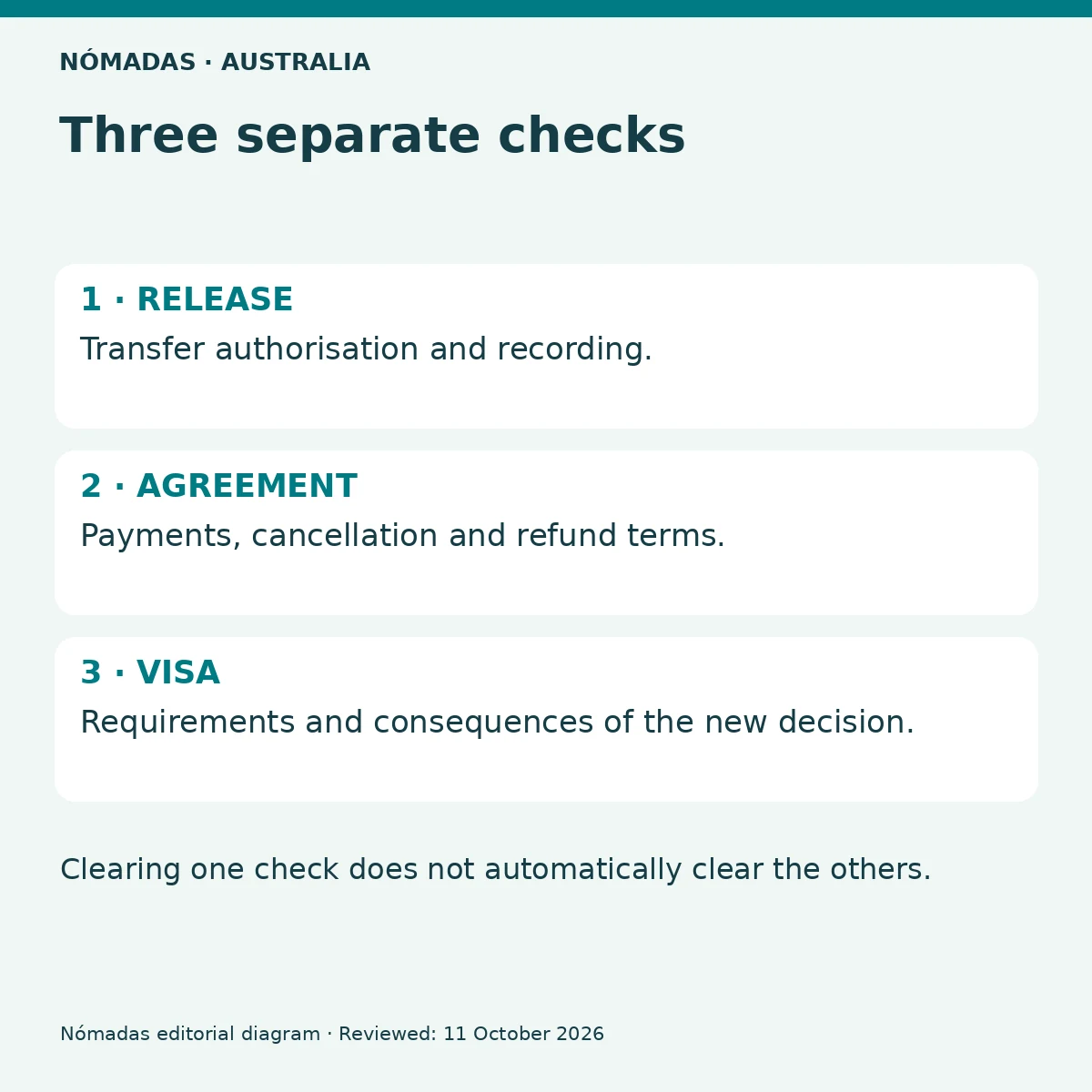
These are different questions. A release does not automatically mean a full refund or permission to undertake any alternative course under the existing visa. Review the academic process, financial agreement and visa conditions separately. Providers must not charge to approve a release; other contractual financial issues require their own assessment.
What changes after June 2027?
The current guidance says the restricted period returns to six months on 1 July 2027. Recheck the position before relying on that future date. The government has also announced work on a Student visa Transfer stream, but its final procedures should not be assumed from an announcement that development is continuing.
Does completing 12 months settle everything? It does not remove the need to comply with visa conditions or contractual obligations. Can a provider impose a blanket refusal? Read the policy and official guidance: a request should be assessed against the relevant circumstances and rules, with access to the applicable review process.
Explore education options with Nōmadas. Seek an authorised migration professional for advice on your individual visa situation.
Make three separate decisions before changing providers
A provider transfer involves academic permission, financial commitments and visa compliance. A positive answer to one question does not settle the other two. Start with a document folder and a list of unresolved questions, rather than paying a new enrolment fee based on a conversation or an advertisement.
Identify what you want to improve. Is the problem course content, the timetable, travel time, student support or a difference between the offer and the service provided? Describing the problem helps you compare solutions. A different class at the current institution might address it; another course might be a better educational fit. Neither should be selected simply on a promise of extending your stay.
Build a timeline from the actual documents
- Collect your visa grant and every Confirmation of Enrolment, including preliminary English and later qualifications.
- Record the start of each course, the principal course, visa expiry and your proposed transfer date.
- Add the steps already taken: enquiries, offers, payments, acceptance and release requests. Link each entry to its evidence.
- Ask the institution to confirm in writing the restriction period applicable to your circumstances.
- Check that response against current official guidance before making a new commitment.
Write dates unambiguously, such as 15 March 2027. Students and institutions may use different numerical date formats. Keep the original documents alongside your summary: your own spreadsheet helps organise the discussion but does not establish enrolment or permission to transfer.
Examples that help identify the right questions
These examples illustrate planning questions; they are not client stories or immigration decisions. The official student factsheet explains how different commencement dates interact with the temporary restriction. Ask the provider to confirm how the rules apply to your documented circumstances.
| Your situation | What to check first |
|---|---|
| You were studying before October 2026 | Identify the principal course and time completed; do not automatically reuse advice received under earlier settings. |
| You study English before a Diploma | Keep both CoEs. The English course start is not interchangeable with the principal course start. |
| You intend to move after June 2027 | Recheck both the education transfer rules and the migration procedure available at that time. |
| You have an offer but have not completed a transfer | Keep the offer and relevant dates; do not assume a sales discussion establishes the required formal position. |
For example, a student might arrive in January, begin English in February and start the principal course in July. Those are three different dates. The purpose of the timeline is to prevent the flight date being used as the academic reference point. Include any deferral, replacement CoE or interruption in your enquiry instead of relying on a simple calendar calculation.
Compare the full cost of staying and transferring
A lower advertised tuition fee does not necessarily mean a cheaper overall study plan. Calculate the alternatives in Australian dollars first, because that is the currency of local commitments. If funds come from overseas, obtain a current transfer quote and record both the amount paid in your home currency and the AUD expected to arrive. An old exchange rate is not a guaranteed future price.
| Budget item | Information to obtain |
|---|---|
| Current course | Outstanding balance, due dates, any applicable refund and its expected payment date. |
| New course | Total tuition, materials, enrolment charges, instalment schedule and exclusions. |
| Accommodation and travel | Possible relocation costs, commuting expenses and existing contractual commitments. |
| Other requirements | Documentation or professional advice costs, where relevant and individually quoted. |
| International payment | The final AUD received, disclosed charges and estimated transfer timing. |
Compare two scenarios: continue with the current plan and transfer to the proposed course. In the transfer scenario, add all new costs and deduct only refunds confirmed in writing. Keep amounts still under consideration in a separate column. If the plan depends on an uncertain refund or immediate employment, it is not yet a reliable budget for making the move.
There is no useful universal saving estimate: contracts, course choices and cities differ. Our Australian student wages and budgeting guide helps distinguish income, expenses and assumptions. Permission to work should never be treated as a guarantee that earnings will fund tuition or a transfer.
Prepare a clear request with evidence
Set out the current course, proposed course, reason for the request and supporting documents. Arrange the information so someone unfamiliar with your case can understand the sequence without searching through scattered messages. If the issue concerns delivery or support, provide dates, correspondence and responses. If it concerns what was advertised, keep the original offer and explain the difference you experienced.
Do not exaggerate events or submit unnecessary personal information. Use the institution’s designated channel for sensitive documents. Request acknowledgement, a reference number where available and the expected assessment timeframe. A written decision provides a stronger basis for planning than a verbal assurance.
The Standard 7 guidance distinguishes the outcome recorded in PRISMS from a paper release letter: a physical letter should not be treated as the only possible record. If the request is refused, check the reasons, complaints and appeals procedure, and the stated time limits before deciding what to do next.
A practical enquiry template
“I am considering a transfer from [course name and code] to [course and institution]. Please confirm my principal course, the commencement date used for the transfer restriction and the applicable process. My reason is [factual explanation], supported by the attached documents. Could you explain what further evidence is needed, the expected assessment timeframe and how the outcome will be communicated?”
This is an organisational template, not an official form or a promise of approval. Adapt the fields to your circumstances. If you have not identified an appropriate alternative course, begin with educational comparison rather than inventing an offer to complete the request.
Assess the next institution beyond its advertised fee
Ask about course content, duration, entry requirements, campus, timetable and assessment methods. Compare the learning outcomes with your educational or career goals. A cheaper option that does not suit your English level or objectives can create another problem after the transfer.
If you are planning from overseas, assess the whole pathway before booking travel: English preparation, the following qualification and each provider’s requirements. If you are already in Australia, include the actual commute, study routine and financial commitments you currently have. A campus visit or discussion with academic staff can answer questions that a price comparison alone cannot resolve.
Prepare for 2027 without treating an announcement as a current process
In the government’s 2 October 2026 statement, a new Student visa transfer stream was announced for 1 July 2027. That future pathway must be distinguished from the current provider-release procedure. Do not assume a present-day offer settles a future visa application, its cost or processing time.
For planning, set a review date before any major payment and again before the intended transfer. Keep the version and date of the guidance you relied on. If the rules or your circumstances change, revisit the plan. This is particularly useful when a package starts in 2026 but the principal qualification or proposed transfer falls in 2027.
Practical questions before your next step
Is moving to another city the same as changing providers?
Not necessarily. Check the legal provider and campus named in the enrolment, what changes academically and what procedure the institution requires. A new address alone does not establish the answer to a provider-transfer question.
Does a new offer prove that I have been released?
No. Keep the documents separate and ask which stage has been completed and which conditions remain outstanding. An offer may support an assessment without proving that every step has been satisfied.
What should I do if I disagree with the decision?
Read the reasons and the appeal policy. Organise the disputed points and supporting documents. Before approaching an external body, identify which service covers your institution and the type of complaint; a single referral is not appropriate for every education provider.
What should I bring to an education consultation?
Bring your CoEs, study objectives, budget, timeline and specific questions. Avoid posting passport information or other sensitive details in public comments. Nómadas can help compare educational options; an authorised professional should assess your individual migration position.
Should I stop attending while waiting for an answer?
Do not treat a pending request as permission to disregard existing obligations. Ask your institution how to manage attendance and assessments during the process, and obtain appropriate advice if your circumstances prevent participation.
Your next step: organise the timeline and compare alternatives before paying. Use the budgeting guide and contact Nómadas for educational guidance — contact page in Spanish.
If the transfer requires another visa, also consult our student visa renewal guide and check its official sources before making a decision.